
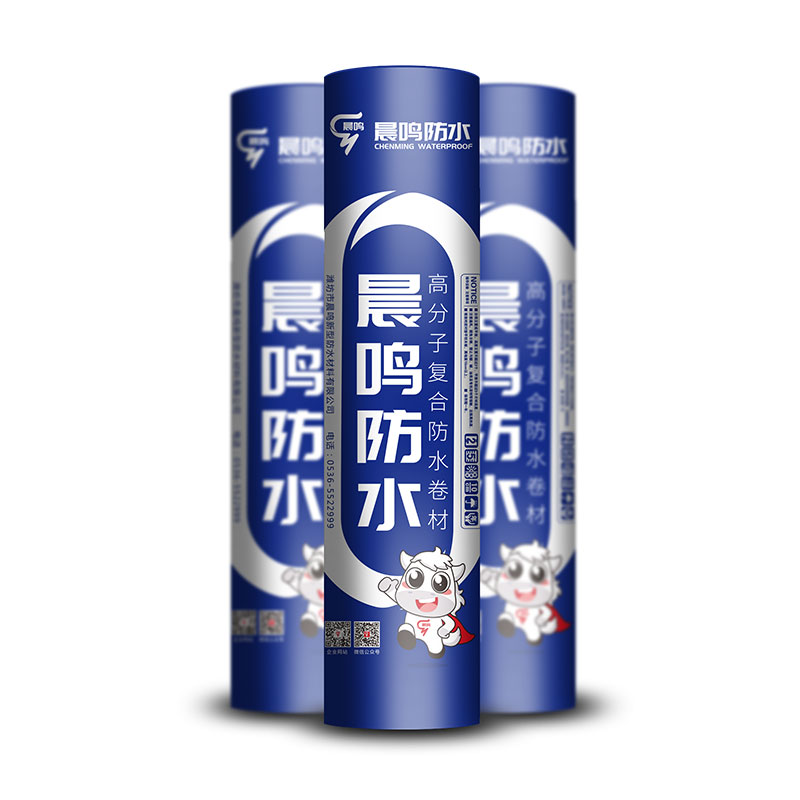
The polymer composite waterproofing membrane is a composite waterproof material made by adding additives to improve performance. It integrates four layers of sheet materials: a reinforced protective layer, an anti-aging layer, a waterproof layer, and an adhesion-enhancing layer.
Product Features
- The product is composed of different materials, so its performance is significantly improved. In particular, it is independently equipped with an anti-aging layer, which greatly prolongs the service life of the product, up to more than 50 years.
- Both upper and lower surfaces of the product are rough, and the non-woven fabric fibers have an irregular cross structure, forming three-dimensional meshes. This gives it high tensile strength, strong impermeability, good low-temperature flexibility, small expansion coefficient, low water遇水效應(yīng), strong deformation adaptability, and a large friction coefficient. It can be used with a variety of adhesives, achieving good bonding effect.
- When bonding this product to a cement base surface, pure cement slurry can be used as the adhesive. The pure cement slurry can directly enter the meshes on the surface of the membrane and integrate with the cement as it sets. Since cement slurry is free from problems such as aging, mildew, and hydrolysis, the bonding is permanently firm and not easy to peel off.
- After the construction with this product, the surface of the waterproof layer can be directly decorated (such as pasting ceramic tiles, floor tiles, mosaics, applying cement slurry, etc.)
- The construction with this product has no special requirements on the moisture content of the leveling layer (base layer); construction can be carried out as long as there is no standing water, and the construction quality is reliable.
- This product belongs to the resin-based polyethylene series polymer waterproofing membranes and is a non-toxic, pollution-free green and environmentally friendly product.
Product Specifications
- Mixing ratio (by weight): cement : water : V07 polymer waterproofing adhesive;
- During preparation, first add water and adhesive into the container and stir, then add 32.5# cement and fully stir until there are no lumps or precipitates, and it becomes a paste, which can then be used;
- The prepared cement adhesive must be used up within 4 hours to prevent moisture evaporation and solidification.
Construction Technology
Inspect the leveling layer → Clean the base layer → Prepare cement adhesive → Make the additional layer → Base layer construction → Protective layer → Curing
First, spread the membrane in advance and align it, then fold and roll up both ends of the membrane. Pour the prepared cement adhesive onto the base layer and spread it evenly with a scraper. Then push and pave the membrane forward, and promptly use a scraper to remove air trapped inside the membrane and scrape off excess adhesive. The bonding rate between the membrane and the leveling layer should be ≥ 85%.
- Construction of roof waterproof layer: The isolation layer, waterproof layer, and additional layer are all joined by lapping, bonded with cement adhesive, with a width of 10cm. The seams of the additional layer and the waterproof layer should be staggered by more than 5cm.
- Construction of basement waterproof layer seams: Adopt a 10-15cm lapped cover strip joint method, and the cover strips are bonded with high molecular synthetic adhesive.
- The lap width of the waterproof membrane is 8-10cm for the long side and 10-15cm for the short side. The seams of adjacent sheets should be staggered by more than 100cm, and the corners between walls and the ground should be more than 30cm.
After the membrane is paved, a 2cm thick 1:5 cement mortar protective layer needs to be applied on the waterproof layer, which is applied in two times and cured by sprinkling water. When the polymer composite waterproofing membrane is bonded to the main structure, cement materials with special matching are used as the adhesive.
;)